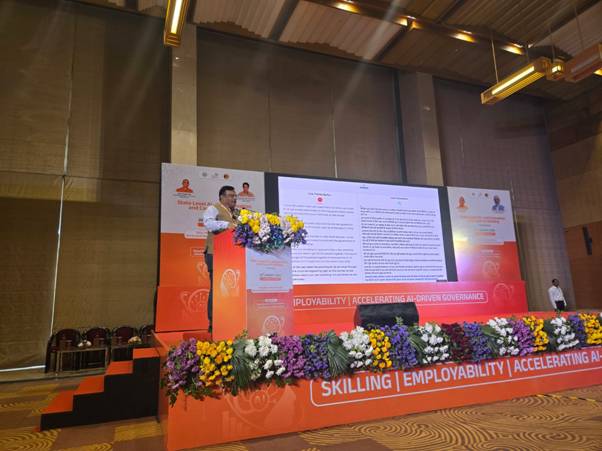
Lucknow: The Digital India Bhashini Division (DIBD) under the Ministry of Electronics and Information Technology showcased voice-based multilingual artificial intelligence solutions at the Artificial Intelligence Innovation and Capacity Building Conference organised by the Centre for e-Governance (CEG), Department of Information and Electronics, Government of Uttar Pradesh, in Lucknow on January 20, 2026.
The conference brought together senior officials of the Uttar Pradesh government, representatives of the Government of India, industry partners and academic institutions to deliberate on the adoption of artificial intelligence in the state, digital skill development and strengthening innovation capacity. The event featured technical sessions on AI applications, industry collaboration, skill development initiatives and state-level AI programmes, including the FutureSkills Prime programme and the AI Pragya initiative, aimed at building institutional and human capacity for responsible and inclusive AI adoption.

A dedicated technical session focused on the Bhashini platform and its role in enabling multilingual and voice-first digital governance. The session highlighted the use of translation APIs, automatic speech recognition, text-to-speech and conversational AI tools for integration into citizen-centric services and administrative workflows, ensuring inclusive access to digital public services across diverse linguistic groups. A live demonstration of Bhashini’s speech-to-text and translation tool, Shrutlekh, showcased real-time transcription and multilingual translation for governance-related use cases.
Addressing the session, Amitabh Nag, Chief Executive Officer, Digital India Bhashini Division, delivered a presentation titled “Sharing Experiences in Co-Creating AI-Based, Voice-First, Multilingual Platforms.” He emphasised that artificial intelligence can effectively serve citizens only when it understands Indian languages and is trained on indigenous data that reflects local contexts and real-world usage.


The session underlined Bhashini’s approach to building multilingual AI capacity rooted in India’s linguistic realities. It stressed the importance of training AI systems on indigenous datasets that represent everyday language usage across regions. The mission promotes citizen participation in language data contribution and validation through collaboration with startups, academia and industry. Capacity building has been embedded across the entire AI lifecycle—from data creation and annotation to real-world deployment and continuous improvement through feedback—ensuring that language AI systems evolve with sustained use.
The presentation also outlined the operational scale of the Bhashini platform, which currently supports more than 36 languages in text and over 22 languages in voice, offers access to more than 350 AI language models, and is integrated with over 500 websites and more than 100 live use cases. The platform also covers regional dialects such as Awadhi and Braj, enabling deeper local engagement.
The participation of the Digital India Bhashini Division reaffirmed its commitment to supporting state governments in implementing multilingual, voice-enabled and AI-driven solutions to enhance accessibility, service delivery and citizen-centric digital governance. This engagement aligns with the Government of India’s vision of integrating Indian languages into digital public infrastructure and promoting inclusive, AI-enabled governance across states.












 https://www.youtube.com/watch?si=RtToJsBhYBatUrym&v=mOuYNSdhjHA&feature=youtu.be